Friday, July 30, 2010

Computer problems

Alas, the true enemy of any blogger, semi computer failure.. Some problems are coming up, I could continue, but I'd really rather wait until I know I'll be able to save my work.

I continue my science and element collecting though, and there will be lots to come!

Thanks for patience,
~Ben

Wednesday, July 21, 2010

Platinum

Platinum is a dull silver metal, most well known for it's resistance to corrosion. It is known as a "Noble metal", similar to the Noble Gases, because it does not react much with anything.

Atomic name is Pt, atomic number is 78 (Right before Gold, which is similar in many respects) and atomic weight is 195. It's electron configuration is 2, 8, 18, 32, 17, 1.

Platinum is most times used for it's resistance to corrosion, and has long been used for jewelry and certain scientific components that require something that will not corrode or rust away after much use. Fuel cells, which mix Hydrogen and Oxygen into water and create electricity as a byproduct, are known to be expensive because the metal that touches these two gases must not corrode in the presents of pure oxygen, so most times, is Platinum.

Some very old light bulbs used Platinum wire to seal through glass, because it bonded well to glass and expanded the same amount as the glass, but this method isn't used due to the price of Platinum. As I write this the price of one ounce(an ounce is about the weight of 6 US nickel coins) of Platinum is over $1,500 , higher than the price of Gold per ounce which is currently just below $1,200.
This is my Platinum sample. The wire is actually Platinum-plated Nickel, as this much pure platinum might cost over $50. These two wires, if un-coiled, are about 6 inches long, and the whole foot of Platinum-plated Nickel wire cost me about $10. I used these in a fuel cell project, because as mentioned above, Platinum works far better than most other metals in this application. There is probably less than 2 mg (milligrams, 1/1000th of a gram, a US nickel weighs 5 grams) of platinum in this whole picture, but hey, I can say I own a few million atoms of it.

Thanks,
~Ben

News: I got a Geiger Counter in the mail today, which is a device to sense radioactivity. It is a kit, and I can't assemble it without a bit of help, but once I get it going I'll do a post on radioactive Thorium.

Monday, July 19, 2010

Aluminum

Aluminum is a very common metal, and has a light dull grey color. It is fairly easy to melt and cast, and scrap is easily available in many forms.

Atomic name is Al, number is 13, weight is 26.981, and it sits in the "poor metal" section of the periodic table. Most common Isotope is Aluminum-27 with 14 neutrons, but traces of Aluminum-26 have been found and are very slightly radioactive.

Aluminum is one of my favorite metals, as it doesn't easily corrode due to a protective oxide layer which forms quite fast, but doesn't flake off like rust on Iron, keeping the Aluminum under the surface safe from corrosion. It's melting point is only 1220 F, which can easily be made by a wood or charcoal fire if you keep good airflow.

Aluminum is generally very common construction material, being fairly cheap, far lighter than steel, but still good strength. It's used in many airplanes or helicopters for these traits. It is also an extremely good electrical conductor, 2/3rds as good as copper, but 1/3rd as heavy, making one of it's most common uses electrical power lines.

Almost all structural Aluminum is alloyed with small amounts of most commonly Copper and Zinc, to make it less prone to cracking. The most common alloy is known as "6061" Aluminum, and can have up to 1% of Silicon, Iron, Copper, Manganese, Magnesium, Chromium, Zinc, and Titanium, but most times contains less than 5% other metals.

Here are my samples
Sample 1: These are all items I cast myself, from right to left: A water-cast blob, made by pouring liquid metal in water, a "medallion", made just for the fun of it, and the result of pouring aluminum into a hole in loose soil. The large lump is what I had left over, so I poured it all into a cooking pan.
Sample 2: This is a small heat sink from something electronic. Aluminum conducts heat very well, similar to electricity, so by putting aluminum vanes on a hot object, the heat is carried out the vanes and dissipated into the air. Used quite commonly in computers, because the processor chips get hot.
Sample 3: This is an aluminum plate, I don't know what it was for, but my dad got a pile of them as scrap from a former job (Same job as the copper slab)
Sample 4: One of the easiest samples, Aluminum foil (Sometimes called Tin foil, but it's been made out of aluminum for quite some time now)
Sample 5: Soda can, another easy one to get, however it doesn't really show what the surface of aluminum looks like, because there's a label on the outside and a thin plastic coating on the inside.
This is another sample of Aluminum, a good example of structural aluminum, a 30 foot antenna tower my dad owns. My dad has lots of interesting stuff, doesn't he?

All in all, Aluminum is quite a useful metal, and not hard to get a sample of. I have many more samples than this, some are quite large though, so I left them out.

Thanks again for reading!
~Ben

Coming soon: Lead, Thorium, Radium.

Friday, July 16, 2010

Experiment: Electrolysis

Electrolysis is a process of using electric current (Generated by any means) to artificially separate elements in a compound. The pure elements (Or new compounds in some cases) can therefor be purified where no chemical reaction can yield them.

One of the most basic electrolysis experiments is electrolyzing water. Water is Hydrogen Oxide, or H2O (Meaning two Hydrogen, one Oxygen). The most basic way to do this experiment is take a 9-volt battery (The small square kind), hook a paper clip on each lead (But don't let them touch!), then submerge both leads in water. Bubbles will form on both paper clips, but one should have twice as many bubbles, as water is "H2O" there is twice as much Hydrogen than Oxygen. If you change the setup a little bit, you can easily make these electrodes go into a container, and store your precious Hydrogen and Oxygen!
This is my setup. It's hard to see because it's in a clear bowl sitting on carpet, sorry about that, but I have insulated wire (coated in plastic) with a small portion of the insulation (plastic) stripped off at the end, because bubbles will only form on the conductive metal part. After making sure my two glass vials where FULL of water, I stuck the wires into them as to catch every tiny bubble of Hydrogen and Oxygen.
I fill the vials with water because one Hydrogen starts forming, I don't want there to be any air mixed in, as air has Nitrogen and Oxygen and it would be impure, but because water is a liquid and not a gas, it is easily pushed out by the Hydrogen. Make sure you put the cap on the vials BEFORE taking them out of the water! You don't want any air mixed with your newly isolated elements.

So this is a very basic process for "Isolating" (purifying) the elements Hydrogen and Oxygen, and can quite easily be done at home. I intend to make a much better system for this though, and maybe sell pure Hydrogen or Oxygen samples later, if anyone wants them that is.

This is not my post on either Hydrogen or Oxygen, because I'm still collecting more interesting samples for them, and want to wait until I have the best array possible. I can get a sample of Hydrogen that's radioactive, and is sealed in a glass vial with chemicals that glow because of the radioactivity! However I can't afford that just yet... So it will be a while.

Thanks for reading!

~Ben

Thursday, July 15, 2010

News

Sorry for not doing an element recently, but I am looking at lots of interesting samples to buy! I have a few on their way, but I'll try to do another one tomorrow, maybe Lead or Aluminum.

I also received my shipment of sample vials, they are very nice. Since I bought bulk, I could sell a few off, but most likely I will wait until I have extra samples to sell with them. Comment if interested.
There they are, all cute and small. I also bought some larger ones for larger samples, but they aren't quite as.. Adorable. As I have these, I can now store several gas samples I haven't been able to in the past, such as electrolyzed Hydrogen and Oxygen, along with a few others.. But I'm waiting on Hydrogen until I have some special Isotopes to show off, which will be worth it I guarantee.

I will also be buying some glass tubing and hopefully learn to blow glass, this will open up invaluable possibilities such as melted-shut glass tubes (called ampoules) I can store reactive elements in permanently, along with gas-discharge lights (See Neon post for info on those) for different gases, possibly even more advanced vacuum-electric devices.

Stay tuned, and remember donations will bring more exciting samples!

~Ben

Tuesday, July 13, 2010

Americium

NOTE: Americium is a radioactive element. Please do not "play" with radioactivity unless you are very well informed to what you are dealing with, and always keep in mind there is ALWAYS some risk.


Americium (am-er-ee-see-um) is a fairly normal looking silver-grey metal, I have no experience working with it as the only piece I can get is a tiny piece of foil, and melting or sanding would prove quite hazardous. The name, oddly, came from a former element named Europium after the continent of Europe, the discoverer decided it worthy to name it after the Americas because of this.

Americium's atomic symbol is Am, number is 95, and the most common isotope is Am-241, having 146 neutrons, and a half life of about 450 years. It appears in the Actinoid section of the periodic table, directly after Plutonium, which is quite a dangerous bomb-making element.

Being an Actinoid metal (Most of which are radioactive or synthetic), it is quite unusual, and I believe completely synthetic, meaning never occurs in nature. It is rare in the fact that it is very commonly used in nearly every house in America, crimped into a steel bead, in all common smoke detectors.

For safety sake, I'm not going to tell you specifically how to get it out, but I will say the entire smoke detector I used was only $4.50, so it must not be to expensive to make today.

Americium emits Alpha particles and low energy Gamma rays(See Radioactivity), Alpha particles are quite weak and can't penetrate even a thin piece of paper, and the Gamma rays are so low power that they do no harm for only short term exposure. Smoke detectors have shielding which makes them completely safe, but if you somehow got a piece of this inside you (In the form of sanding dust, which is why I never sand or grind my radioactive samples) it would probably do some damage just because the exposure time could be your whole life if it got stuck in your system.

I don't know the process for manufacturing Americium, and I don't know of any uses besides smoke detectors, or general "check sources" (set radiation levels for testing or calibrating radioactivity sensing devices). I have seen it used in a nifty device called a Spinthariscope, which shows radioactive decay by using any radiation source (Commonly Americium) and a chemical or compound that lights up in contact with radiation, releasing small flashes of green light whenever an Alpha particle hits it.
This is my Americium, crimped into a steel bead. It's hard to see, but there is a slight indent in the top of the steel bead, at the bottom of this indent is a very tiny piece of Americium foil, held firmly in place by steel that has been crimped around the edges. I wouldn't try to remove it from this steel bead, as it is safely stored, and fine for any experiments I might want to do with it. I might get a better picture if I have time.


Thanks for reading!

~Ben

Monday, July 12, 2010

Neon

Neon is a colorless, odorless gas that is very well known for it's bright orange luminescence. All of my samples are in unusual light bulbs.

Neon is a Noble Gas that's atomic symbol is Ne, and atomic number is 10. It's most common Isotope is Neon-20 (abbreviated Ne20), which has 10 Protons and 10 Neutrons, however there are small percentages of Ne21 and Ne22. The electron configuration of the Neon atom is simply 2, 8.

Being a Noble Gas, Neon is very non-reactive, due to the fact that all of the Noble Gases have a "comfortable" number of electrons, and almost never require any or have any extra. This makes there not many uses for Neon, because there are no natural compounds, Neon only ever occurs in it's pure form. Some scientists have managed to make very basic compounds with other Noble Gases, but not for Neon.

The most well known, and I believe most common use for Neon gas is in lighting, as low-pressure Neon will glow bright orange when high voltage is applied. You've probably seen Neon signs, although not all Neon signs have Neon gas, only a redish-orange color (Which you might've noticed is one of the most common colors in Neon signs) Neon signs consist of long tubes full of low-pressure Neon, with an electrode(Metal bar connected to a wire that goes through the glass) at either end. When high voltage is applied to the electrodes, electrons arc through the Neon gas from one electrode to the other, which Ionizes the Neon atoms causing them to release light.

This "Arc" is similar to a spark you might get from scuffing on carpet with socks on, but since the Neon is under a vacuum (very low pressure), the arc gets more "fuzzy" and not such a sharp streak of light as seen in normal air, which makes it a more pleasing light source. The vacuum also lowers the voltage required to make the Neon ionize.

Neon is not the only gas that lights up like this, almost any gas under a vacuum will light up similar to Neon. Normal air under a vacuum (Which is 78% Nitrogen, 20% Oxygen, and small percentages of others) will light up a blue-purple color, but Neon is much brighter, which is why it's more commonly used.

An interesting note about Neon, and most of the Noble Gases, is that since they do not form compounds, they are most commonly found in very small percentages in normal Air. The process to purify Neon from the air is to cool the air down so cold, that the gases in it start to turn to liquids(Every element will go from solid to liquid to gas as you heat it up, since Neon is naturally a gas, cooling it puts it back to liquid stage, similar to cooling steam to get water). Since every gas turns to liquid at a different temperature, they simply cool it down slowly, and sort out the different gases as they liquify. This process can yield Nitrogen, Oxygen, Carbon dioxide, Neon, Argon, and a number of other gases, in very pure form.

Here are some Neon bulbs I managed to photograph:
This is an old bulb manufactured by General Electric, it is the same shape and size as a regular light bulb and even screws into a regular socket, but instead of a thin Tungsten filament, it has two Electrodes (The two half circles) and is filled with low pressure Neon. The high voltage from normal house wiring is enough to make it arc through the Neon, causing the familiar orange glow like in Neon signs. These bulbs are quite rare today, and I'm lucky to have access to them.
This is a small Neon "indicator" bulb, it's barely 1/4 inch in diameter. It's called an indicator bulb because it was used in houses to indicate things in the dark, and it's Neon because there was too high voltage for normal light bulbs. Illuminated light switches very commonly have a bulb exactly like these in them, you can tell if it's Neon if it's orange (Like below) and if it seems to flicker slightly.

It's not turned on as you can see, but you can clearly see the two electrodes inside the bulb. They are not touching, because when the light is turned on, electrons must arc through Neon gas (contained in the bulb) to complete the circuit, and this arc causes the Neon to light up. See below for it turned on!
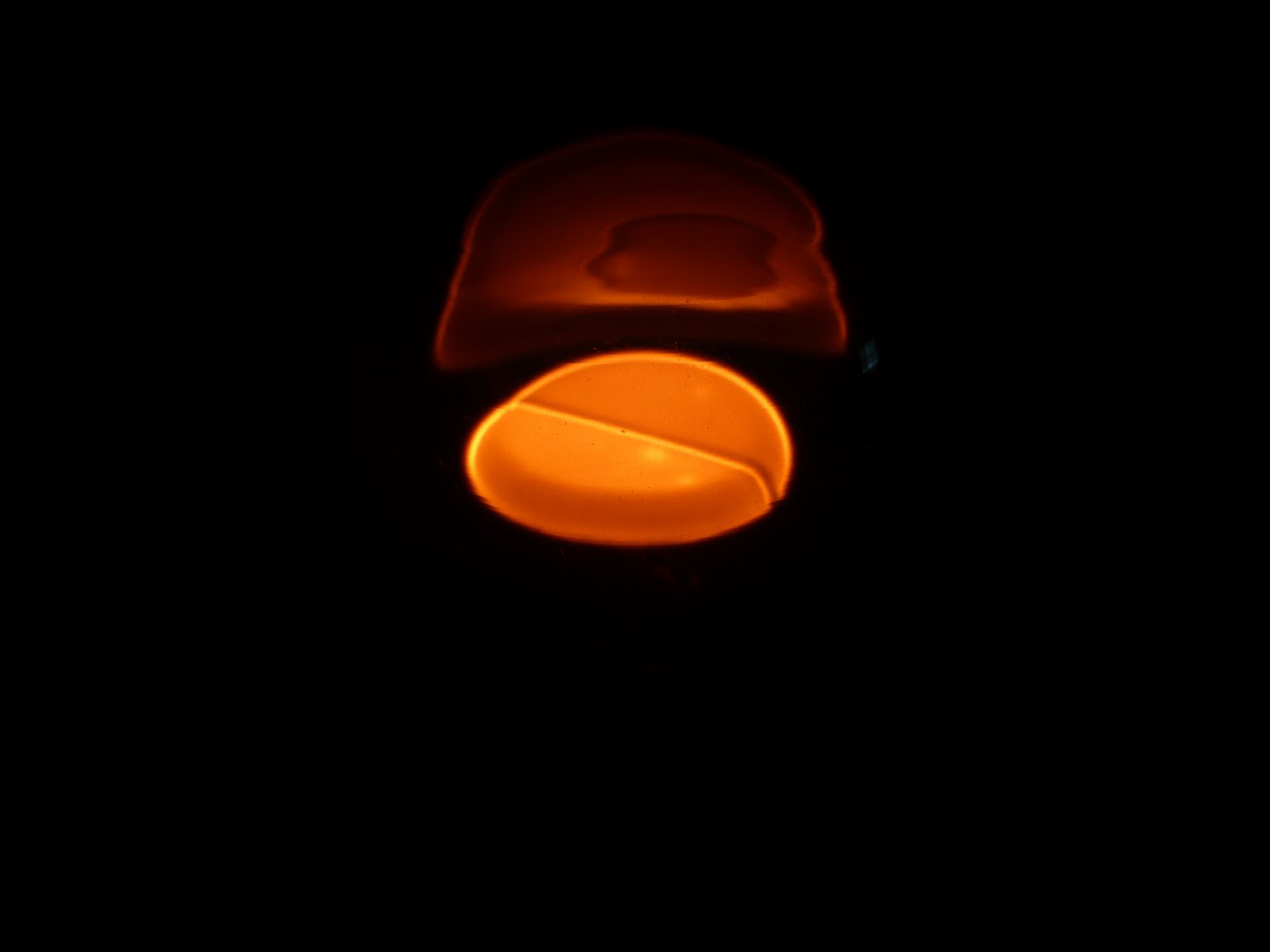
These two bulbs are indicator bulbs like above, and are also very small, about the size of a bulb from those strings of Christmas lights. Only the orange one is Neon, and you can see, it has the same kind of electrodes inside as above. The glass bulb is once again filled with low pressure Neon gas. Since DC (Direct current) electricity is being used, only one of the electrodes lights up.

The blue bulb is actually very similar inside, but it has a different gas mixture which creates Ultraviolet light, which is invisible to the human eye. In order for it to glow visibly, the inside of the glass bulb is coated with special compounds, that turn Ultraviolet light into normal visible light, called "phosphors" (Not to be confused with the element "Phosphorous"). This coating is why the bulb appears opaque, not clear like the Neon one. These phosphors are used because the bulb can be made to glow almost any color, unlike Neon, which is always orange. I've seen green, blue, white, and yellow with phosphors though.

This concludes my post on Neon, thanks for reading!

~Ben

P.S. If you enjoy this blog and want to help me make it better, the best thing you can do is tell your friends and family about it, or donate a few dollars towards my sample budget!